Frequencies on Purpose: The Players Listening to Games Like Nobody Else Is
Most players hear a game. These people study it.
There's a corner of the internet — small, intensely focused, running on Discord threads and shared spectrogram screenshots — where a community of audio-obsessed players has quietly built a discipline around a single premise: game developers are hiding things inside sound. Not just Easter eggs in dialogue. Not just clever musical callbacks. We're talking coordinates embedded in ambient noise, binary sequences tucked into reverb tails, and Morse-coded rhythms buried so deep in a soundtrack's low-end that you'd need audio software to even know they were there.
They call themselves codec breakers, audio archaeologists, sonic detectives — the name depends on who you ask and which server you're in. But the mission is consistent. Pull the audio apart. Run it through the tools. See what's hiding.
The Find That Started Everything
The moment that galvanized a lot of people in this space traces back to a discovery in an indie horror game a few years ago. A player running the game's ambient basement track through a spectrogram — basically a tool that visualizes sound as a frequency map — noticed what looked unmistakably like a face rendered in the visual noise. It wasn't random static. The shape was too deliberate.
That single screenshot spread fast. Developers confirmed it was intentional. And suddenly, a whole generation of players who'd spent years just listening to games started looking at them.
From there, the methodology evolved quickly. Spectrograms became standard. People started running music through reverse pitch filters, analyzing waveform spikes for Morse code timing, and scrubbing through ambient tracks frame-by-frame for anything that didn't belong. What they found — across dozens of different titles — was wild enough to suggest this isn't a fluke. It's a practice.
The Toolkit These People Are Running
You don't need a recording studio to do this. That's part of why the community grew the way it did. Most of the core tools are free or cheap.
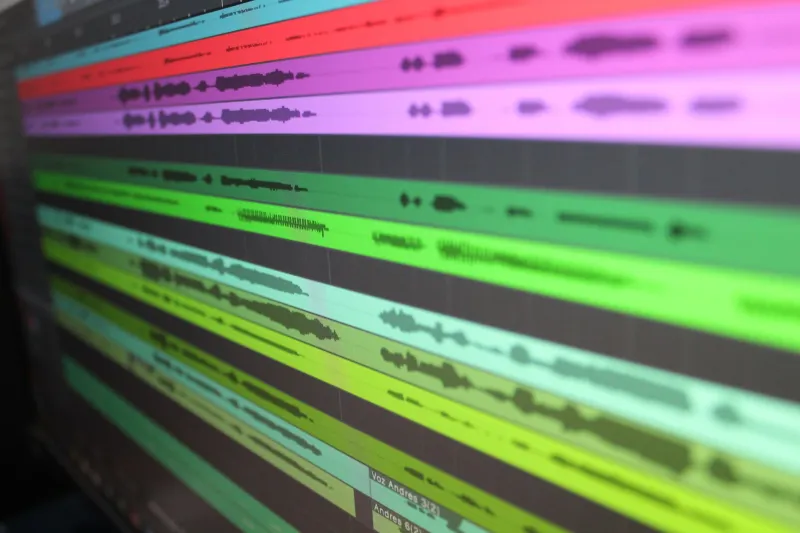
Audacity is the baseline — open source, widely used, capable of visualizing spectrograms and running basic frequency analysis. Beyond that, people use Sonic Visualiser, which lets you layer multiple analysis plugins and get granular with what you're seeing. For Morse code specifically, there are web decoders that'll take a waveform pattern and spit out text. Some members of these communities have even written their own scripts to automate parts of the scan process.
The workflow usually looks like this: extract the audio file from the game's data package, import it into analysis software, run a spectrogram, look for anything that reads as structured or geometric in the visual output, then cross-reference with Morse timing patterns, binary sequences, or known cipher keys. If something pops, screenshot it, post it to the thread, and let the group pile on.
It sounds methodical. It is. But there's also a lot of chasing ghosts.
Real Finds vs. Apophenia
Here's where it gets complicated, and where the community itself is actually pretty honest: not everything they find is intentional.
The human brain is extraordinarily good at finding patterns. Put enough people staring at noise for long enough and someone will find a face, a word, a sequence that feels deliberate. Audio compression artifacts can look structured in a spectrogram. Random reverb decay can produce timing that mimics Morse rhythm if you're already primed to look for it.
The more rigorous members of these communities have started applying a loose standard for what counts as a real find: it needs to decode into something meaningful — a coherent message, a recognizable coordinate, a phrase that connects to in-game lore. Ambiguous shapes don't make the cut. Neither do sequences that only work if you apply three separate cipher layers and squint.
But the finds that do meet that bar? They've been stunning.
One RPG had a recurring ambient track in its endgame zones that, when run through a spectrogram, displayed a string of coordinates. Players plugged them into a map tool and landed on a real-world location — a small town in the Pacific Northwest. Nobody's fully decoded why yet, but the coordinates were too precise to be random. A separate shooter title had what appeared to be a binary string embedded in the low-frequency hum of a loading screen track. Decoded, it produced a URL. The URL was dead, but the domain had been registered by the developer's parent company two months before launch.
Developers almost never comment on these finds publicly. Which, depending on your read, is either professional discretion or confirmation by silence.
Why Devs Would Do This
The honest answer is that nobody outside the studios knows for certain. But the theories that circulate in these communities make sense when you think about game development culture.
Devs are, as a group, deeply playful with their own work. They've been hiding initials in texture files, leaving personal messages in unused code, and embedding references to inside jokes since basically the beginning of the medium. Audio is just a newer frontier — one that became viable as game soundtracks grew more complex and as open-world ambient design gave composers and sound engineers hours of runtime to work with.
There's also the ARG angle. Alternate reality games — those elaborate cross-platform puzzles that blur the line between game and real life — have used embedded audio clues for years. Some developers have clearly taken that toolkit and started applying it to standard releases, without ever officially announcing an ARG exists. The result is a treasure hunt that only the most obsessive players will ever find, which, from a certain perspective, is exactly the point.
The players who are most into this aren't doing it for in-game rewards. There usually aren't any. They're doing it because the idea that a developer left a message specifically for someone willing to look this hard is genuinely moving to them. It's a secret handshake between creators and the people paying the closest attention.
The Community Living Inside the Signal
What's interesting about these groups isn't just the findings — it's the culture that's built up around the practice. These aren't random forum posts. These are organized communities with documented methodology, shared archives, and real expertise that's developed over years.
People in these spaces have backgrounds in audio engineering, music production, cryptography, and data analysis. They bring actual professional tools to the hobby. And when a big find drops, the collaborative energy is intense — dozens of people working in parallel, each applying a different angle, building on each other's work in real time.
It's citizen science applied to entertainment. And it's genuinely producing results that studios' own marketing teams never anticipated.
Listen Different
Next time you're running through a game's open world and that ambient track kicks in — the one that's just wind and low strings and some kind of distant mechanical hum — maybe don't skip past it. Maybe record it. Maybe pull it into a spectrogram and see what the noise looks like when you can see it.
Might be nothing. Probably is nothing.
But a whole community of people has proven, repeatedly, that sometimes it's exactly what it looks like: a message, sitting in the signal, waiting for someone who knew to look.